
 English
 Deutsch
 Italia
March 16, 2026
By travel
30 Must-Visit Temples in South India: A Divine Blend of Art, Architecture & Spirituality
South India is a land where spirituality flows through every stone, every chant, and every sunrise ritual. The temples of South India are not just places of worship — they are living museums, architectural marvels, and eternal centres of devotion. Built over centuries by great dynasties like the Cholas, Pallavas, Vijayanagara kings, and the Nayakas, these sacred structures embody the soul of Dravidian civilisation.
The iconic gopurams (towered gateways) rising dramatically into the sky, the intricate carvings of gods, celestial dancers, and mythological creatures, and the vast temple tanks reflecting golden light — all of these make South Indian temple architecture unlike anything else in the world. Whether you are a pilgrim seeking divine blessings, a traveller drawn to history and culture, or a curious soul in search of meaning, the famous temples in South India promise an experience that transcends the ordinary.
This guide takes you through 30 must-visit temples — from the soaring towers of Tamil Nadu to the forest shrines of Kerala and the boulder-strewn ruins of Karnataka. Each is a pilgrimage site in South India that deserves a place on every spiritual traveller’s bucket list.
- 1. Meenakshi Amman Temple – Madurai, Tamil Nadu
- 2. Tirupati Balaji Temple (Venkateswara Temple) – Tirupati, Andhra Pradesh
- 3. Ramanathaswamy Temple – Rameswaram, Tamil Nadu
- 4. Brihadeeswarar Temple – Thanjavur, Tamil Nadu
- 5. Virupaksha Temple – Hampi, Karnataka
- 6. Padmanabhaswamy Temple – Thiruvananthapuram, Kerala
- 7. Chidambaram Nataraja Temple – Chidambaram, Tamil Nadu
- 8. Sabarimala Temple – Pathanamthitta, Kerala
- 9. Murudeshwar Temple – Murudeshwar, Karnataka
- 10. Guruvayur Temple – Guruvayur, Kerala
- 11. Sringeri Sharada Peetham – Sringeri, Karnataka
- 12. Hazara Rama Temple – Hampi, Karnataka
- 13. Ekambareswarar Temple – Kanchipuram, Tamil Nadu
- 14. Kamakshi Amman Temple – Kanchipuram, Tamil Nadu
- 15. Sri Ranganathaswamy Temple – Srirangam, Tamil Nadu
- 16. Tiruchendur Murugan Temple – Tiruchendur, Tamil Nadu
- 17. Kukke Subramanya Temple – Sullia, Karnataka
- 18. Lepakshi Veerabhadra Temple – Lepakshi, Andhra Pradesh
- 19. Chamundeshwari Temple – Mysuru, Karnataka
- 20. Udupi Krishna Temple – Udupi, Karnataka
- 21. Annamalaiyar Temple (Arunachaleswarar) – Thiruvannamalai, Tamil Nadu
- 22. Suchindram Temple (Thanumalayan Temple) – Suchindram, Tamil Nadu
- 23. Nellaiappar Temple – Tirunelveli, Tamil Nadu
- 24. Shore Temple – Mahabalipuram, Tamil Nadu
- 25. Airavatesvara Temple – Darasuram, Tamil Nadu
- 26. Parthasarathy Temple – Chennai, Tamil Nadu
- 27. Kollur Mookambika Temple – Kollur, Karnataka
- 28. Attukal Bhagavathy Temple – Thiruvananthapuram, Kerala
- 29. Mannarasala Temple – Alappuzha, Kerala
- 30. Kanaka Durga Temple – Vijayawada, Andhra Pradesh
- Unique Temple Architecture of South India
- Travel Tips for Visiting Temples in South India
- Conclusion
- Frequently Asked Questions (FAQs)
- 1. Which is the most famous temple in South India?
- 2. What is special about South Indian temple architecture?
- 3. Which temples are part of the Char Dham of South India?
- 4. What is the best time to visit temples in South India?
- 5. Are South Indian temples open to non-Hindus?
- 6. What is the largest temple complex in South India?
- 7. What is the significance of temple tanks in South India?
1. Meenakshi Amman Temple – Madurai, Tamil Nadu
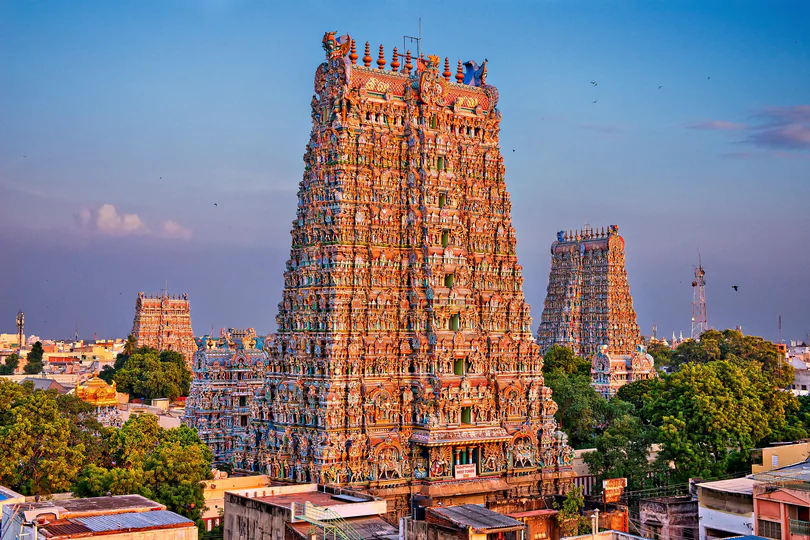
Dedicated to Goddess Meenakshi and Lord Sundareswarar, the Meenakshi Amman Temple in Madurai is arguably the crown jewel of South Indian temple architecture. Rising above the city with 14 colourful gopurams adorned with thousands of sculpted figures, this temple is a sensory masterpiece. Dating back over 2,000 years and rebuilt magnificently by the Nayaka rulers in the 17th century, the complex encompasses 45 acres and draws millions annually. The Meenakshi Tirukalyanam festival, celebrating the divine wedding of Meenakshi and Shiva, is a spectacular event not to be missed.
2. Tirupati Balaji Temple (Venkateswara Temple) – Tirupati, Andhra Pradesh
Perched atop the Tirumala Hills at 3,200 feet, the Venkateswara Temple is the most visited pilgrimage site in India — and among the wealthiest religious institutions in the world. Dedicated to Lord Venkateswara (Balaji), an avatar of Vishnu, the temple draws 50,000 to 100,000 devotees daily. The presiding deity is adorned with precious jewels and the famous Brahmotsavam festival sees the entire Tirumala Hill come alive with unmatched devotion. The rituals of tonsuring (offering one’s hair) make this a uniquely personal spiritual experience.
3. Ramanathaswamy Temple – Rameswaram, Tamil Nadu
One of the 12 Jyotirlingas and a key Char Dham pilgrimage site, the Ramanathaswamy Temple in Rameswaram is of enormous religious significance. Dedicated to Lord Shiva and built in the Dravidian style, it is celebrated for having the longest temple corridor in the world — stretching over 1,200 metres. Pilgrims ritually bathe in its 22 sacred theerthams (wells) before offering prayers. The temple is associated with Lord Rama himself, who is believed to have worshipped Shiva here after defeating Ravana.
4. Brihadeeswarar Temple – Thanjavur, Tamil Nadu
A UNESCO World Heritage Site, the Brihadeeswarar Temple (also called the Big Temple) was built by the great Chola emperor Rajaraja I in 1010 CE. Dedicated to Lord Shiva, its 216-foot vimana (tower) was the tallest in the world at the time of its construction. The temple showcases the pinnacle of Chola craftsmanship — from exquisite Nataraja bronzes to breathtaking frescoes and the massive Nandi bull carved from a single rock. It remains a monument to the extraordinary achievements of the Chola civilisation.
5. Virupaksha Temple – Hampi, Karnataka
Amid the surreal boulder-scattered landscape of Hampi, the Virupaksha Temple stands as one of the oldest functioning temples in the world, with continuous worship for over 1,300 years. Dedicated to Lord Virupaksha (Shiva), it served as the royal temple of the Vijayanagara Empire. The 50-metre gopuram and intricate painted ceilings inside the temple hall are awe-inspiring. The annual chariot festival draws thousands of devotees, and the elephant Lakshmi, who gives blessings at the temple gate, is a beloved resident.
6. Padmanabhaswamy Temple – Thiruvananthapuram, Kerala
The Padmanabhaswamy Temple in Thiruvananthapuram is dedicated to Lord Vishnu in his cosmic reclining form (Ananthasayanam) on the serpent Adi Shesha. It is among the wealthiest temples in the world, with vaults containing incomparable riches including gold, jewels, and ancient artefacts. The temple’s blend of Kerala and Dravidian architecture is distinctive, featuring an 80-foot gopuram and intricate mural paintings. Entry is restricted to Hindus, lending it an air of sacred exclusivity. The Alphashy Utsavam festival is celebrated with great grandeur.
7. Chidambaram Nataraja Temple – Chidambaram, Tamil Nadu
The Chidambaram Nataraja Temple is unique in all of South India — it enshrines Lord Shiva in his cosmic dance form (Nataraja) and in the formless Chidambara Rahasyam (the secret of space). One of the Pancha Bhuta Stalas representing the element of space (Akasha), this Dravidian architectural gem dates back over 2,000 years and features magnificent gopurams adorned with sculptures of 108 classical Bharatanatyam dance poses. The Natyanjali dance festival held here every year during Maha Shivaratri is a spiritual and cultural celebration of the highest order.
8. Sabarimala Temple – Pathanamthitta, Kerala
Deep in the forests of the Western Ghats, accessible only on foot through a demanding jungle trek, the Sabarimala Temple is dedicated to Lord Ayyappa. This is one of the largest annual pilgrimages in the world, attracting between 40 and 50 million devotees during the Mandalam-Makaravilakku season (November to January). Devotees observe a strict 41-day penance (vratha) before undertaking the journey. The temple’s remote, mystical setting and the unbroken devotion of millions make the Sabarimala pilgrimage a profoundly moving experience.
9. Murudeshwar Temple – Murudeshwar, Karnataka
The Murudeshwar Temple in coastal Karnataka is renowned for its 123-foot Shiva statue — the second tallest in the world — gazing serenely over the Arabian Sea. Dedicated to Lord Shiva, the temple complex sits dramatically on Kanduka Hill, surrounded by turquoise waters on three sides. A modern gopuram equipped with a lift allows visitors panoramic views of the coastline. The temple’s setting, combining divine artistry with natural coastal beauty, makes it one of the most visually stunning spiritual places in South India.
10. Guruvayur Temple – Guruvayur, Kerala
Known as the Dwarka of South India, Guruvayur Temple is among the most sacred temples in Kerala. Dedicated to Lord Guruvayurappan (Krishna), it is one of the most visited pilgrimage sites in South India, drawing thousands of devotees daily. The idol inside — dating back thousands of years — was brought here by Guru (Brihaspati) and Vayu (wind god), giving the town its name. The temple’s elephant processions, Guruvayur Ekadasi festival, and the peaceful thidambu procession are highlights of its rich ritual calendar.
11. Sringeri Sharada Peetham – Sringeri, Karnataka
Established by Adi Shankaracharya himself in the 8th century, Sringeri Sharada Peetham is one of the four sacred mathas (monasteries) of Hinduism. Located in the verdant forests of Chikkamagaluru district, the peetham is dedicated to Goddess Sharada (Saraswati). The Vidyashankara Temple within the complex is a masterpiece, with 12 zodiac pillars illuminated in perfect sequence by sunlight throughout the year. The temple’s setting amid dense forest and the Tunga river makes it an extraordinarily peaceful pilgrimage.
12. Hazara Rama Temple – Hampi, Karnataka
The Hazara Rama Temple (meaning ‘thousand Ramas’) served as the private royal chapel of the Vijayanagara kings. Located within the royal enclosure of Hampi, its walls are covered with extraordinary bas-relief friezes narrating the entire Ramayana story — over a thousand panels in all. Dedicated to Lord Rama, the temple is a remarkable narrative artwork in stone. Though smaller than some famous temples, its refined carvings and intimate royal connection make it one of the most captivating temple experiences in Hampi.
13. Ekambareswarar Temple – Kanchipuram, Tamil Nadu
The Ekambareswarar Temple in Kanchipuram is one of the Pancha Bhuta Stalas representing the earth element (Prithvi). Dedicated to Lord Shiva as Ekambareswarar, the temple complex covers over 25 acres and features a magnificent 59-metre rajagopuram. Its most sacred feature is a 3,500-year-old mango tree with four branches believed to represent the four Vedas. Kanchipuram, the City of a Thousand Temples, holds special importance in South Indian religious tradition, and this temple is its grandest jewel.
14. Kamakshi Amman Temple – Kanchipuram, Tamil Nadu
The Kamakshi Amman Temple is one of the most powerful Shakti shrines in India. Dedicated to Goddess Kamakshi — a form of Parvati — and considered one of the three most important Shakti peethas in South India (along with Madurai and Varanasi), the temple was consecrated by Adi Shankaracharya. The seated image of the goddess is serene, holding a sugarcane bow and flowers. The Brahmotsavam and Panguni Uthiram festivals attract enormous crowds of devout pilgrims. The golden gopuram is a visual delight.
15. Sri Ranganathaswamy Temple – Srirangam, Tamil Nadu
The largest functioning Hindu temple complex in the world, Sri Ranganathaswamy Temple at Srirangam covers 156 acres and is surrounded by seven concentric walls — a city within a city. Dedicated to Lord Ranganatha (Vishnu in his reclining form), it is the foremost among 108 Divya Desams. The 73-metre Rajagopuram is the tallest temple tower in Asia. The Vaikunta Ekadasi celebration, when the golden gates open for the public, is among the most spiritually charged events in South India.
16. Tiruchendur Murugan Temple – Tiruchendur, Tamil Nadu
One of the six abodes (Arupadaiveedu) of Lord Murugan, the Tiruchendur Temple sits directly on a rocky seashore in southern Tamil Nadu. The temple’s setting — with waves crashing nearby — is deeply evocative. Dedicated to Lord Subramanya (Murugan), it is believed to be where the deity slew the demon Soorapadman. The temple dates back over 2,000 years and features beautiful Dravidian architecture. Skanda Sashti, celebrated with immense fervour, brings hundreds of thousands of devotees to this sacred sea-cliff temple.
17. Kukke Subramanya Temple – Sullia, Karnataka
Nestled in the lush forests of the Western Ghats near Sullia, the Kukke Subramanya Temple is a highly revered shrine dedicated to Lord Subramanya. It is particularly famous for the Sarpa Dosha Nivarana puja — rituals that alleviate suffering caused by serpent-related karmic afflictions. The temple is believed to be where Lord Subramanya sheltered a divine serpent (Vasuki) under his protection. The forest setting, crystal-clear Kumaradhara river, and powerful rituals make this one of Karnataka’s most important pilgrimage sites.
18. Lepakshi Veerabhadra Temple – Lepakshi, Andhra Pradesh
The Lepakshi Veerabhadra Temple is an architectural marvel of the Vijayanagara period. Dedicated to Lord Veerabhadra (a fierce form of Shiva), it is famous for a hanging pillar — one of 70 pillars — that appears to float above the ground, defying architectural logic. The temple’s ceilings are painted with some of the finest Vijayanagara-era murals, depicting scenes from the Ramayana, Mahabharata, and Puranas in vivid colour. The enormous monolithic Nandi bull outside — one of the largest in India — is a breathtaking sight.
19. Chamundeshwari Temple – Mysuru, Karnataka
Perched atop Chamundi Hill, 1,065 metres above Mysuru city, the Chamundeshwari Temple is dedicated to Goddess Chamundeshwari — the ferocious slayer of the demon Mahishasura and the presiding deity of Mysuru. The seven-storeyed Dravidian gopuram rises majestically above the hill, visible from across the city. The giant Nandi bull carved from black stone along the path up the hill is another iconic landmark. The Dasara festival celebrated here with spectacular processions is one of the most famous in India.
20. Udupi Krishna Temple – Udupi, Karnataka
The Udupi Krishna Temple is one of the holiest Vaishnava shrines, established by the philosopher-saint Madhvacharya in the 13th century. Devoted to Lord Krishna, the deity is viewed through a nine-holed window (Navagraha Kitiki) — a tradition born from the devotion of Kanakadasa, who was denied entry but miraculously had the temple wall open for him. The eight mathas (monasteries) surrounding the temple conduct worship in rotation every two years. Udupi is also famous for the cuisine that bears its name, originating from the temple kitchens.
21. Annamalaiyar Temple (Arunachaleswarar) – Thiruvannamalai, Tamil Nadu
The Arunachaleswarar Temple, one of the Pancha Bhuta Stalas representing the fire element (Agni), stands at the foot of the sacred Arunachala hill. Dedicated to Lord Shiva as Annamalaiyar, the temple complex covers 25 acres with four towering gopurams. The sacred Karthigai Deepam festival — when a giant flame is lit atop the Arunachala hill — is visible from 30 kilometres away and attracts millions. The Girivalam (circumambulation) of the hill, especially on full moon nights, is a deeply meditative spiritual practice.
22. Suchindram Temple (Thanumalayan Temple) – Suchindram, Tamil Nadu
The Thanumalayan Temple at Suchindram, near Kanyakumari, is unique in South India for enshrining the Hindu Trinity — Brahma, Vishnu, and Shiva — in a single Lingam called Sthanunatha. Built over many centuries and expanded by the Pandya, Chola, and Travancore rulers, the temple features superb Dravidian carvings, musical pillars that produce seven notes when struck, and an 18-foot Hanuman idol sculpted from a single stone. The atmosphere here is one of ancient peace and rare sanctity.
23. Nellaiappar Temple – Tirunelveli, Tamil Nadu
The Nellaiappar Temple in Tirunelveli is a Dravidian masterpiece dedicated to Lord Shiva (Nellaiappar) and Goddess Parvati (Kanthimathi Amman), housed in adjacent shrines connected by a golden arch. Known for its musical pillars and elaborate corridor carvings, the temple’s golden corridor (Swarna Vimanam) is a sight of rare beauty. The Brahmotsavam and Panguni Uthiram festivals are celebrated with wonderful pageantry. The temple also houses a corridor dedicated to Goddess Parvati in a rare dual-shrine configuration of exceptional artistic merit.
24. Shore Temple – Mahabalipuram, Tamil Nadu
A UNESCO World Heritage Site, the Shore Temple at Mahabalipuram (Mamallapuram) is one of the oldest structural stone temples in South India, built by the Pallava king Narasimhavarman II in the 8th century. Dedicated to both Lord Shiva and Lord Vishnu, the temple faces the Bay of Bengal and its weathered granite structure has stood against waves and wind for over 1,300 years. The Pancha Rathas (five monolithic chariots) nearby are equally remarkable. The temple complex is part of the Group of Monuments at Mahabalipuram.
25. Airavatesvara Temple – Darasuram, Tamil Nadu
Another jewel in the Chola crown and a UNESCO World Heritage Site, the Airavatesvara Temple at Darasuram was built by Rajaraja Chola II in the 12th century. Dedicated to Lord Shiva and associated with the divine elephant Airavata, the temple is renowned for its miniature but breathtakingly detailed sculptures. Its most remarkable feature is a chariot-shaped mandapa with wheels. The intricate carvings here demonstrate the Chola sculptural tradition at its most refined, with delicate figures carved into every available surface.
26. Parthasarathy Temple – Chennai, Tamil Nadu
The Parthasarathy Temple in Triplicane, Chennai, is one of the oldest Vishnu temples in the city, originally built by the Pallava kings in the 8th century. Dedicated to Lord Parthasarathy (Krishna as Arjuna’s charioteer), the temple is unique in depicting Krishna with battle scars — one of the few temples where this form is worshipped. It is one of the 108 Divya Desams and has deep connections to the Alvar saints. The temple’s gopurams, mandapas, and sacred tank make it a significant Vaishnava pilgrimage site.
27. Kollur Mookambika Temple – Kollur, Karnataka
Nestled in the dense forests of the Western Ghats on the banks of the Souparnika river, the Mookambika Temple is dedicated to Goddess Mookambika — a form of Shakti combined with Saraswati. Associated with Adi Shankaracharya, who is said to have installed the Srichakra (sacred geometric symbol) here, the temple draws scholars, students, and devotees from across India. The forest setting creates an ambience of deep spiritual power. The annual Navaratri celebrations bring out the goddess’s magnificence in spectacular form.
28. Attukal Bhagavathy Temple – Thiruvananthapuram, Kerala
The Attukal Bhagavathy Temple holds the Guinness World Record for the largest gathering of women at a single religious event — the Attukal Pongala, when over 2.5 million women cook rice pudding as an offering to the goddess in the streets surrounding the temple. Dedicated to Goddess Attukal Bhagavathy (a form of Durga/Kannaki), the temple is known as the ‘Sabarimala of Women.’ The 10-day festival is one of the most extraordinary expressions of women’s devotion in the world.
29. Mannarasala Temple – Alappuzha, Kerala
The Mannarasala Temple near Alappuzha (Alleppey) is a rare and extraordinary serpent shrine, dedicated to Sarpa Yakshi and the Naga (serpent) deities. The temple grove contains over 30,000 serpent idols placed over centuries by devotees seeking blessings for fertility and to overcome Sarpa Dosha. The temple is managed by women of the Namboodiri tradition, with a woman serving as the chief priestess — an unusual feature in Kerala’s temple tradition. The annual Ayilyam celebration in the Malayalam month of Karkidakam is the temple’s most important festival.
30. Kanaka Durga Temple – Vijayawada, Andhra Pradesh
The Kanaka Durga Temple sits magnificently atop Indrakeeladri Hill overlooking the Krishna river in Vijayawada. Dedicated to Goddess Kanaka Durga, one of the most powerful Shakti manifestations, the temple is one of the most important pilgrimage sites in Andhra Pradesh. The image of the goddess is said to be Swayambhu (self-manifested). The Dasara Navaratri festival here lasts nine nights with each day devoted to a different manifestation of the goddess, attracting hundreds of thousands of devotees in a blaze of colour, lights, and devotion.
Unique Temple Architecture of South India
The temples of South India represent one of humanity’s greatest architectural traditions — the Dravidian style — which evolved over 2,000 years into forms of breathtaking grandeur and complexity.
Towering Gopurams: The most recognisable feature of South Indian temple architecture, gopurams are massive pyramidal gateway towers covered with coloured stucco sculptures of gods, demons, celestial beings, and mythological scenes. The tallest — the 73-metre Rajagopuram at Srirangam — is visible from miles away.
Intricate Carvings and Sculptures: Every surface of a Dravidian temple is a canvas for stone artistry — from the sensuous apsaras (celestial dancers) of Belur and Halebid to the animated Ramayana friezes at Hampi’s Hazara Rama Temple. Stone carvers of the Chola, Pallava, and Vijayanagara periods achieved levels of refinement that remain unsurpassed.
Magnificent Mandapas and Pillared Corridors: Temple halls supported by elaborately carved pillars create meditative spaces of extraordinary beauty. The famous ‘musical pillars’ at Suchindram and Nellaiappar temples produce musical notes when tapped — a testament to ancient acoustic engineering.
Sacred Temple Tanks: Most South Indian temples feature pushkarani (sacred tanks), used for ritual bathing and purification. These tanks, often surrounded by steps and small shrines, reflect the gopurams in their still waters, creating hauntingly beautiful vistas.
Travel Tips for Visiting Temples in South India
Best Time to Visit: October to March is the ideal season, with cooler temperatures and major festivals. Avoid peak summer months (April–June) when temperatures can exceed 40°C, especially in Tamil Nadu and Andhra Pradesh.
Dress Code: Most temples require modest clothing. Men should wear lungis, dhotis, or trousers; women are expected to wear sarees or salwar-kameez. In some temples (like Guruvayur), men must remove their shirts before entering the sanctum.
Footwear: All temples require shoes to be removed before entering. Most major temples have secure footwear storage facilities available.
Photography: Photography is prohibited inside the sanctum sanctorum (inner shrine) of most temples. Some temples allow photography in outer areas. Always check before photographing.
Entry Restrictions: Some temples (like Padmanabhaswamy and Guruvayur) are open only to Hindus. Research the policies of each temple before visiting.
Festival Seasons: The most rewarding visits coincide with major festivals — Navaratri (October), Karthigai Deepam (November/December), Pongal (January), and the respective annual Brahmotsavams of each temple. Book accommodation well in advance during these periods.
Conclusion
The temples of South India are far more than stone and mortar — they are living embodiments of devotion, artistry, and a civilisational genius that has endured for over two millennia. From the cloud-piercing gopurams of Madurai to the forest shrines of Kerala and the sea-kissed sanctuaries of the Coromandel Coast, each temple tells a story that resonates deeply with spiritual seekers and cultural explorers alike.
Whether you come to offer a prayer, trace the arc of Chola genius in carved stone, or simply stand in awe before towers that have watched civilisations rise and fall, South India’s sacred temples will leave you changed. They invite you into a world where time slows, beauty overwhelms, and the divine feels genuinely close.
Add these 30 temples to your spiritual travel bucket list, and let South India’s divine heritage touch your soul in ways you never expected.
Frequently Asked Questions (FAQs)
1. Which is the most famous temple in South India?
The Tirupati Venkateswara Temple in Andhra Pradesh is arguably the most visited temple in South India — and the world — receiving up to 100,000 devotees daily. The Meenakshi Amman Temple in Madurai is also a top contender for its architectural grandeur and global recognition.
2. What is special about South Indian temple architecture?
South Indian temple architecture, known as Dravidian style, is distinguished by its towering gopurams (gateway towers) covered with colourful sculptures, intricate stone carvings, vast pillared corridors, sacred temple tanks, and the concept of the entire complex as a symbolic model of the cosmos (Mount Meru). The Chola, Pallava, Pandya, and Vijayanagara empires each contributed to this tradition’s extraordinary richness.
3. Which temples are part of the Char Dham of South India?
The South Indian Char Dham (four sacred abodes) traditionally refers to Rameswaram (Tamil Nadu), Badrinath (Uttarakhand), Dwarka (Gujarat), and Puri (Odisha) — though Rameswaram is the only one located in South India. Some traditions also refer to a Tamil Nadu-specific set: Chidambaram, Srirangam, Tiruvannamalai, and Madurai.
4. What is the best time to visit temples in South India?
October to March is the best time overall, with pleasant weather across the region. Festival seasons — particularly Navaratri (October), Karthigai Deepam (November/December), and Pongal (January) — offer the richest cultural experiences, though they also bring larger crowds. Early mornings at major temples provide a more intimate and meditative atmosphere.
5. Are South Indian temples open to non-Hindus?
Most South Indian temples welcome visitors of all faiths to their outer precincts and many inner areas. However, some temples — including Padmanabhaswamy Temple (Thiruvananthapuram) and Guruvayur Temple (Kerala) — restrict entry to Hindus only. It is always advisable to check the rules of individual temples before visiting.
6. What is the largest temple complex in South India?
The Sri Ranganathaswamy Temple at Srirangam, Tamil Nadu, is the largest functioning Hindu temple complex in the world, covering 156 acres with seven concentric enclosure walls and 21 gopurams. It is a virtual temple city within the island of Srirangam.
7. What is the significance of temple tanks in South India?
Temple tanks (called pushkarani or theertham) are sacred water bodies within or adjacent to temple complexes. Devotees take a ritual bath before worship to purify themselves. These tanks are also vital for temple rituals, festival processions (the deity is floated on a raft), and historically served as important community water sources. Many are believed to have sacred healing properties.